Every old house keeps a little of the town's memory inside its walls, and the Cambridge House is no exception. Built in 1916, it has watched the valley change for more than a hundred years — through the railroad era, the farm booms and busts, two world wars, and the slow arrival of the highway travelers who pass through today.
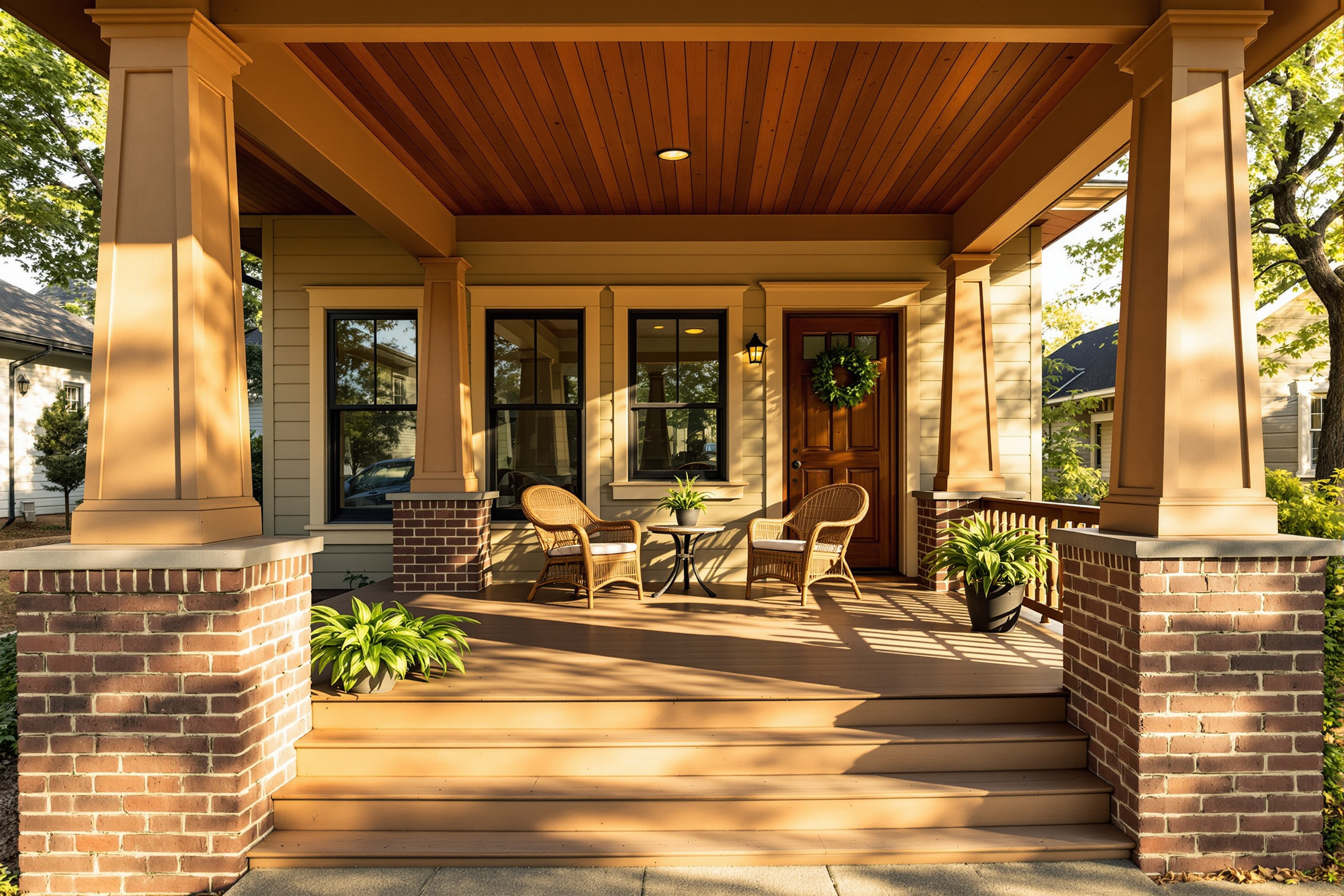
A doctor's house on First Street
The house was raised in 1916 as the home of the town's country doctor and his family. In a rural community that size, the doctor was one of a handful of people who knew nearly everyone, and the house he built reflected both his standing and the practical good sense of the era. It was designed in the American Craftsman style that was sweeping the country at the time — an architecture that prized honest materials, hand-built quality, and comfortable, human-scaled rooms over Victorian ornament.
The results are still visible in every room. A wide, welcoming front porch runs across the facade beneath deep eaves. Inside are original hardwood floors, a brick fireplace, and a built-in china cabinet of the kind that factory-built houses could never quite match. The upper floor holds bedrooms tucked beneath the roofline; the whole house is lit by an astonishing thirty-seven windows, a luxury in a time before central heating made large panes of glass a gamble.
It is worth pausing on what that job actually involved. A country doctor in 1916 covered an enormous territory by horse, buggy, and eventually automobile, on roads that were mud for much of the year. He set fractures on kitchen tables, delivered babies in farmhouses, and carried much of his pharmacy in a bag; the nearest hospital was a day's effort away, if it existed at all. In towns this size the doctor's house often doubled as his consulting room, with the front parlor pressed into service as a waiting area. The distances that shaped a practice like that are the same distances that shape life in Washington County today.
Craftsman style, explained
If you have never paid much attention to house styles, the Cambridge House is a fine place to start. The Craftsman movement grew out of the Arts and Crafts reaction against mass production, and it favored low-pitched gabled roofs, exposed rafter tails, tapered porch columns on sturdy piers, and built-in cabinetry. The Idaho State Historical Society documents many such homes across the state; you can explore its resources through the Idaho State Historical Society. Once you learn to spot the details, you will see the style echoed in bungalows from Boise to the smallest farm towns.
Quiet years and a careful restoration
Like many grand old houses in small towns, the Cambridge House passed through several hands over the decades and spent long stretches quietly unoccupied. Time is hard on empty buildings, and by the late twentieth century the house needed real work. It was eventually purchased by owners who saw its potential, and after roughly a year of patient renovation the house was brought back to life — original floors refinished, systems modernized, and the porch restored to its old role as the best seat in town on a summer evening.
That restoration is the reason the house survives as a landmark rather than a memory. Today it operates as a small bed & breakfast, though this guide is independent of that business and handles no reservations; our interest is in the building's heritage and its place in the life of Cambridge.
The town around the house
Cambridge grew up as a railroad and agricultural town in the Weiser River valley, a shipping point for livestock, fruit, and timber from the surrounding ranch country. The rail line that gave the town its start is gone now, but its old grade lives on as the Weiser River Trail, a reminder that the same route that once carried freight now carries cyclists and hikers. The valley's ranching character endures in the annual county fair and rodeo, one of the oldest traditions in this part of Idaho.
To understand Cambridge is to understand a pattern repeated across the rural West: a town born of the railroad, sustained by the land, and kept alive today by the travelers who come for the country around it. The Cambridge House stands at the center of that story — a hundred-year-old reminder that good building, like good hospitality, is meant to last.